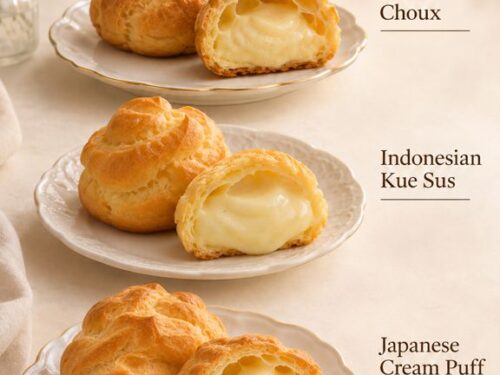
Have you ever bitten into a cream puff and wondered why some are crisp and delicate, while others are soft, creamy, and wonderfully messy?
That’s what I love about choux. The same basic dough can take on so many personalities!
In France, it becomes the foundation of beautiful classic pastries. In Indonesia, we know it as our much-loved kue sus. In Japan, you’ll find cream puffs with everything from soft shells to crunchy cookie tops, generously filled with silky cream.
They belong to the same pastry family, but each brings something different to the table. Let’s take a closer look—without making it feel like a pastry exam!
The Secret to the Perfect Choux
First, what exactly is choux? All three start with pâte à choux, a dough cooked in a saucepan before eggs are gradually mixed in.
In the oven, steam helps the dough puff up, creating space inside for the filling. Think of it as a little pastry home for your cream! The ingredients are simple. Getting the texture right is where the technique comes in.
French Choux: The Classic Foundation

For me, French choux is about balance: a light shell, a lovely airy centre, and enough structure to hold the filling beautifully.
A well-baked shell is usually dry and delicately crisp on the outside. Inside, it should have room for cream, rather than a heavy, doughy centre. Its flavour is gently buttery and not overly sweet, allowing the filling to shine.
Famous French Choux Pastries
You’ll recognise this dough in several classic pastries:
- Profiteroles: little puffs often served with ice cream and chocolate sauce.
- Éclairs: elongated pastries filled with cream and finished with icing.
- Paris-Brest: a choux ring traditionally filled with praline cream.
- Chouquettes: small, unfilled puffs topped with pearl sugar.
- Saint-Honoré: a classic dessert featuring caramel-coated choux puffs.
Some French choux also wear a thin cookie topping called craquelin, which adds crunch and helps create a more even shape. The lesson I take from French technique? A beautiful filling deserves a well-made shell.
Indonesian Kue Sus: Familiar, Comforting, and Creamy

Here in Indonesia, we call it kue sus—and the filling is often the part everyone looks forward to!
Many familiar versions have a tender shell with a slightly chewy bite, filled with smooth, sweet vla, our custard-style filling. Served chilled, it becomes a lovely combination of soft pastry and cool, creamy custard. The kind of treat that makes “just one more” very easy to say.
Favorite Kue Sus Fillings
Vanilla and milk vla are favourites, but there’s plenty of room to play:
- Chocolate for something richer.
- Pandan for its beautiful fragrance.
- Durian for those who love its unmistakable flavour.
- Whipped cream for a lighter filling.
- Diplomat cream—pastry cream lightened with whipped cream—for a little of both.
But Indonesian kue sus doesn’t have to be soft. It can be crisp too! The recipe, baking method, storage, and time spent with the filling all affect the final texture. To me, its charm lies in that familiar, generous creaminess.
Japanese Cream Puffs: A Little Crunch, a Lot of Cream

One popular Japanese style pairs a crisp, crackled shell with a generous helping of silky custard.
That first bite gives you a little crunch, followed by soft cream. Delicious—and perhaps a good reason to keep a napkin nearby! Many versions use a cookie topping for extra texture, although Japanese cream puffs can also have softer shells. The crunchy style is one expression of Japanese choux, rather than a rule for all of them.
Common Japanese Cream Puff Fillings
Fillings might include:
- Vanilla custard.
- Whipped cream.
- Custard and whipped cream together.
- Matcha cream.
- Milk cream, including versions made with Hokkaido dairy.
And that cookie crust? It’s shared pastry territory. French pastry uses craquelin too, so a crunchy top alone doesn’t make a cream puff Japanese.
The Differences at a Glance
These describe common styles, with plenty of delicious overlap.
| Feature | French choux | Indonesian kue sus | Japanese cream puffs |
| Shell | Often light and delicately crisp | Often tender and slightly chewy | Can be soft or crisp; cookie-crust versions add crunch |
| Filling | Pastry cream, whipped cream, or other classic fillings | Frequently vanilla or flavoured vla | Often silky custard, whipped cream, or both |
| Finishing | Plain, craquelin, icing, or caramel | Often simple, letting the filling shine | Cookie crust is popular in crunchy versions |
| Overall appeal | Balance between shell and filling | Familiar flavour and comforting creaminess | Contrast between shell texture and smooth cream |
What Actually Changes the Result?
The difference isn’t simply the country written beside the recipe. A few practical choices make a big impact:
- The Dough’s Moisture: The balance of liquid, flour, fat, and eggs affects how the choux pipes, rises, and holds its shape. That’s why eggs are added gradually—the dough’s consistency matters more than blindly adding every last drop.
- The Baking: The shell needs time to rise, set, and dry properly. Choux that looks golden outside may still need more drying inside.
- The Topping: A thin layer of craquelin adds a crisp, cookie-like bite and changes the way the surface expands.
- The Filling and Storage: Once filled, the shell gradually absorbs moisture from the cream. A freshly filled puff and one chilled for several hours can have quite different textures—even when they came from the same tray!
What Would I Create in My Kitchen?
This is where it gets exciting. I would bring together French choux technique, an Indonesian-inspired filling, and the satisfying crunch found in many Japanese cookie-crust cream puffs.
Imagine a light, airy puff with a delicate cookie top, filled with pandan cream and a touch of gula aren. Or coconut cream. Or durian, if we’re feeling bold!
That’s what I enjoy about pastry: learning the foundations, understanding what each technique brings, and then making something personal.
One dough, so many possibilities. Which one would you reach for first?
Ready to bake? You can find the recipe to create your own at Japanese Chocolate Choux Cream Puff.
From My Kitchen to Yours — Sandra Djohan